The following is a guest post by Harris Lirtzman, former Director of Risk Management for the New York City Retirement Systems in
the NYC Comptroller's Office from 1996-2002 and former Deputy State
Comptroller for Administration from 2003-2007.
The NY Post is having a case of the vapors bad by even Postian
standards (here, here and here). Chalkbeat is in a tizzy. The only
reason that the Daily News isn’t apoplectic is that the Post “owns” the story
about the young woman who claims to have earned a high school degree
without having done anything to “deserve” it. Carmen Farina must be
summarily thrown to the wolves or, better yet, into the nearest volcano,
for presiding over the scandalous practices in her very own schools
that led teachers and administrators to begin “cheating” and “failing”
their students. Thanks to the Post we even know the very minute when
all this nefarious stuff began: 12:00:01 a.m., January 1, 2014—the
millisecond after a Mr. William de Blasio became mayor of New York City
and took control of the City’s school system.
We all have been
told that education reformistas don’t do anything unless it is “data
driven” and informed by “evidence-based practice.” Sadly, the media
outlets that reformistas use to make their case to the public about the
failures of public education, the “monopoly power” of teachers unions
and the awfulness of bad, vampire teachers (“bad” because they belong to
unions and “vampires” because they get health care and pensions) prefer
to panic the public by telling stories using the old propaganda
technique of the “Big Lie.” The “Big Lie” is something so astoundingly
audacious that people believe it when they would dismiss a smaller lie
as foolishness. We teachers, trained to value “facts” and “critical
thinking,” try to refute reformista propaganda with evidence and reason
and are surprised when the “Big Lie” sweeps away everything that stands
before it. Our best bloggers are doing what they can but reformista
propaganda is well-funded and tenacious. Public school teachers need to
find an effective way to tell a counter-narrative that resonates with
the public but which is true to our professional and personal values.
We all have “stories” to tell and it is only by weaving them together
persuasively into a counter-narrative that we have any hope of
countering the flood of “Big Lie” propaganda that washes over us each
day. Here is my “story,” simply one of thousands that we can frame
fully and quickly if we are going to defend public education and protect
our profession.
I was a special education teacher in a high school in the Bronx from
2009-2012. During my tenure "conversation" with my principal in
December 2011, which was an irregular one to say he least, I expected to
be denied tenure because I had been raising serious questions within my
school about widespread violations of student IEPs. I’m certain that
my advocacy on behalf of my students was what precipitated the “tenure
conversation” five months before anyone else in my school had the
“conversation” that year but here’s what I was actually told:
Principal
Grismaldy Laboy: "Mr. Lirtzman, your passing rates are low and are not
consistent with the memo that I sent around to teachers last year that
our school would have a 70% pass rate for each class."
Untenured
Teacher Harris Lirtzman: "I have only failed two students for academic
reasons in the last year. I have failed students who never attended my
class. If a student came to class, made any reasonable effort to do the
work and turned in anything that indicated some grasp of the basic
elements of algebra, the student got at least a 65. Any student I
failed was for attendance reasons."
Principal Laboy: "I don't, and the DOE doesn't, distinguish between absentee and academic failures."
Untenured
Teacher Harris Lirtzman:
"You are aware that I have a first period integrated algebra class.
Several students never attended my class after the first week or
appeared erratically during the term. They were "Long Term Absent." I
worked closely with the attendance teacher here to get the kids to
school on time. What else should I have done? Stand in front of their
homes at 6:00 every morning and kidnap them?”
Principal Laboy: "Mr. Lirtzman, if you'd been able to make your classes more engaging they would have come."
Of course, conversations like this have been going on all around the
City for the last ten years. My chapter leader sent the “grade quota”
memo the principal distributed to central UFT and the district
superintendent
as evidence for teacher coercion by administration to pass LTA students
and, well, just about any student. Nothing. Not a surprise.
Now
I can think of many reasons why Carmen Farina should resign—primarily
her abject failure to sweep Tweed clean of the nest of reformistas
filling up every corner of the place. But because of her willingness to
allow some teachers in some cases to use multiple measures to evaluate
their students? Because administrators began to press teachers to pass
students without regard to attendance or academic performance only
eighteen months ago? I think not.
In a conversation I had this
morning with Geoff Decker, the reporter at Chalkbeat writing the
stories about Farina and the “cheating scandal,” he asked me whether I
thought Farina was “lowering the stakes” in the schools. I tried to
explain to him that Farina hasn’t lowered the stakes in City schools
because she can't lower the stakes in City schools even if she wanted
to: the State sets teacher and principal evaluation standards tied to
student test scores and the Renewal and other schools on the State
"struggling" school list all use graduation rates, credit accumulation
and other accountability measures to assess performance.
The high
stakes connected with reformista accountability—receivership, teacher
reapplication to struggling schools and the specter of being dumped into
the ATR, administrators with feudal power over professional staff—have
resulted in jumped up graduation rates and student test scores for the
last decade and forced credit-recovery miracles and minimum passing
rates stipulated in contractually illegal quotas onto reluctant teachers
since Mayor Bloomberg obtained control over the Department of
Education.
When reformistas put teachers’ careers on the line
but don't hold administrators accountable for the incentive structures
they impose inside their own schools the result is what the Post thinks
it “discovered” this week. Tweed spent ten years trying to convince the
State that "everything's OK here" because Mayor Bloomberg needed to
validate mayoral control. Tweed spent the last eighteen months trying
to convince Governor Cuomo and the State Senate that “everything’s OK
here” because Mayor de Blasio needed to keep them from taking away mayor
control entirely.
At least Chancellor Farina has set up a “task force” to investigate the
nonsense that passes for accountability in our schools—though Farina
might have written one more “Chancellor’s Regulation” giving Richard
Condon and his crew of investigators at OSI even more authority for all
the good a task force will do. No one demanded a "task force" at any
time during the twelve years that Michael Bloomberg controlled the
schools because it served no reformista purpose to do so. My friend,
James Eterno, has been calling for a "truth commission" which would
expose the institutional corruption and fraud that has infested
reformista accountability measures in the City since 2002. Don’t expect
to have the “facts” about the Bloomberg administration’s management of
the schools revealed any more honestly than the “facts” are being told
now about the de Blasio administration’s management of the schools.
Reformista
media will continue to tell the “Big Lie” in all its forms to the
public. We teachers will try to refute the “Big Lie” with facts and
counter-arguments. The audacity and power of the “Big Lie” is a
ferocious thing to behold. We must tell ourselves and the public the
truth and we must tell the public our stories.
But we always
need to understand that our reformista adversaries do and say the things
they want to do and say because they can—evidence, facts,
truth, fairness and data be damned. Mayoral control of the schools was
blissfully wonderful for the NY Post for twelve years. Mayoral control of
the schools became a satanic plot that allowed New York City teachers to stop
educating their students on January 1, 2014. It is useful for our
adversaries to make it so.
The “Big Lie” is powerful and
reformistas will continue to use the “Big Lie” against us until we
teachers can create a story—a deep and coherent counter-narrative—that
the public is willing and able to hear. I don’t yet know how we do that
but I do know that if we don’t do it quickly we will become spectators
spouting “facts” that no one wants to hear while our schools and our
profession are swept away by the “Big Lie” before our very eyes.
Perdido 03

Showing posts with label data fetish. Show all posts
Showing posts with label data fetish. Show all posts
Thursday, August 6, 2015


Thursday, April 30, 2015
Bloomberg's NYCDOE Covered Up Violence In Schools
This isn't a surprise:
Again, no surprise that the Data King's Department of Education underreported violence in public schools because his police department underreported crimes.
Take this NY Times article from July 2013, for example:
Bloomberg's data fetish - the data must always be better!!! - brought about all kinds of manipulation, deception, and outright falsification to how the city government agencies and departments operated.
If there were any independent study of the Bloomberg Years done, it would expose this for all to say.
Alas, there has not and probably will not be and so instead we are left with the myth of the "uber-competent" Mayor Bloomberg.
A review of violent episodes at 10 public schools in New York City found that the Education Department failed to report nearly a third of the cases to the state, as required, according to an audit the state comptroller released on Wednesday.The audit, which examined episodes during the 2011-12 and 2012-13 school years, also found that some were inappropriately classified as less serious than they were.“When incidents don’t get reported or are in effect downgraded, schoolchildren are put potentially in harm’s way,” the comptroller, Thomas P. DiNapoli, said, adding, “The Department of Education can’t risk leaving parents uninformed about what’s going on in their child’s school.”The more than 400 episodes that went unreported at the 10 schools included 50 assaults resulting in injuries, among them one case at Intermediate School 27 on Staten Island in which a student pushed another student over a desk, knocking him to the floor with the desk landing on top of him; 13 sex offenses; and two instances of confiscated weapons.The state uses the city’s annual reports of violent episodes to designate certain schools as “persistently dangerous.” Those schools are required to take steps to reduce violence and to notify parents that they are entitled to enroll their children at a less violent place.
Again, no surprise that the Data King's Department of Education underreported violence in public schools because his police department underreported crimes.
Take this NY Times article from July 2013, for example:
A long-awaited report ordered by the police commissioner in New York has found deficiencies in the Police Department’s efforts to detect whether its crime statistics are being manipulated.
...
The report was released on Tuesday, more than two years after Mr. Kelly empaneled a committee of former federal prosecutors to review the department’s internal crime-reporting system.
The committee’s report did not directly address how often such manipulation occurred, but it identified vulnerabilities in the department’s system for auditing the integrity of its crime statistics.
Before each report of a crime is entered into the department’s computer system, relatively few controls exist to prevent officers on the street from refusing to fill out any paperwork or for supervisors to alter paperwork back in the station house, the review found.
While praising the department on the considerable resources devoted to auditing crime statistics, the committee noted that most of those efforts were directed at identifying “human error” — that is, unintentional mistakes in a police officer’s paperwork. But for “an officer who wishes to manipulate crime reporting,” the report said there were “few other procedures in place that control the various avenues of potential manipulation.”
...
The 60-page report describes several instances of manipulation in which felony crimes were marked down as misdemeanors. In one instance “a desk officer scratched out the item values in order to bring the total to below the $1,000 threshold for grand larceny,” which is a felony.In another instance, police paperwork for lost property “described a complainant who ‘lost property’ following an assault by multiple individuals,” according to the report, which added, “On its face the narrative appears to describe a robbery.”
In the aggregate, the report found, the effect of such errors, intentional or otherwise, on crime statistics was not negligible. “A close review of the N.Y.P.D.’s statistics and analysis demonstrate that the misclassifications of reports may have an appreciable effect on certain reported crime rates,” the report said.
The report noted, for instance, that Police Department auditors had already detected an error rate in 2009 suggesting that grand larcenies were undercounted that year by 2,312. The adjusted figures represent a 4.6 percent increase over the figures that the department issued that year.
Bloomberg's data fetish - the data must always be better!!! - brought about all kinds of manipulation, deception, and outright falsification to how the city government agencies and departments operated.
If there were any independent study of the Bloomberg Years done, it would expose this for all to say.
Alas, there has not and probably will not be and so instead we are left with the myth of the "uber-competent" Mayor Bloomberg.
Saturday, February 21, 2015
NYSED Can't Come Up With The Data To Show Why Sheri Lederman Is "Ineffective" On The APPR Test Component
The Times-Union covers the Sheri Lederman story:
Lederman is suing NYSED over the "ineffective" test growth score, but NYSED is trying to have the suit dismissed:
Okay, they're arguing "No harm, no foul," since Lederman was rated "effective" overall and she faces no disciplinary action as a result of the "ineffective" sub-component rating, but if Cuomo gets his education reform agenda that will make test scores 50% of the APPR rating, this kind of sub-component evaluation will have a major effect on teachers in the near future.
So it's interestin to see that NYSED can't come up with the data to show why Lederman is "ineffective" on her state test sub-component - but they can't:
NYSED is going the coward's route, looking to have the suit dismissed on the "No harm, No foul" rule, and for all I know, that just may work in this case.
But eventually they're going to have show cause for why teachers are being rated "ineffective" on the state test sub-component - especially if and when Cuomo ups the state test sub-component to 40% or 50% of APPR overall - and then they WON'T be able to argue the "No harm No foul" rule.
In Sheri Lederman's 18 years of teaching, failing her students has never been a concern.
Her employers consider her to be an "extraordinary teacher" and her students' parents refer to her as "one of the most influential educators" their children have ever had. Her students, years after they sat in her fourth-grade classroom, cite her as an integral part in their strong academic careers.
But when the State Education Department's teacher ratings rolled out in September, the Great Neck public school teacher was found to have scored only one point out of 20 — deeming her ineffective — in the Office of Assessment's Growth Score and Rating system. Lederman's students, however, met or exceeded test standards at more than twice the state's average scores since the new testing standards were implemented two years ago, according to State Education Department data.
Lederman is suing NYSED over the "ineffective" test growth score, but NYSED is trying to have the suit dismissed:
Lederman was told by the State Education Department that she can't appeal her growth rating score, because it is a subcomponent of her composite score of "effective" for the 2013-2014 school year. Lederman was told her only option was to sue, so that's what she has done, with the aid of her husband who is serving as her attorney.
Now, the state is attempting to dismiss Lederman's suit, which claims the evaluation system and Lederman's rating is "arbitrary, capricious and an abuse of discretion," according to documents filed with the state Supreme Court in Albany. The state argues that Lederman's concern about parents finding out her low score is unfounded, as the information can't be accessed through a Freedom of Information Act Request.
Additionally, the state argues her other evaluation scores are high enough that her low growth rating does not bring her overall composite score to the level requiring disciplinary action, according to court documents.
The State Education Department declined comment on the case, citing the pending litigation.
Okay, they're arguing "No harm, no foul," since Lederman was rated "effective" overall and she faces no disciplinary action as a result of the "ineffective" sub-component rating, but if Cuomo gets his education reform agenda that will make test scores 50% of the APPR rating, this kind of sub-component evaluation will have a major effect on teachers in the near future.
So it's interestin to see that NYSED can't come up with the data to show why Lederman is "ineffective" on her state test sub-component - but they can't:
Neither Lederman nor the district administration has been provided any data to support why she received only one out of 20 points.
NYSED is going the coward's route, looking to have the suit dismissed on the "No harm, No foul" rule, and for all I know, that just may work in this case.
But eventually they're going to have show cause for why teachers are being rated "ineffective" on the state test sub-component - especially if and when Cuomo ups the state test sub-component to 40% or 50% of APPR overall - and then they WON'T be able to argue the "No harm No foul" rule.
Wednesday, February 4, 2015
Andrew Cuomo: Tests Are The Only Objective Data That Can Be Trusted To Evaluate Teachers
From the Buffalo News:
So in short, since "how you appeal to students, your disposition in the classroom, your rapport in the classroom, the energy you bring in the classroom" are all "too hard to judge and hard to evaluate and hard to come up with a statewide system," we'll just use tests.
Which is a horrific idea.
We've been over this before, but let's go over it again:
The tests are not "objective."
They are written by humans who make subjective choices about what goes on them (and what doesn't.)
The grading criteria is subjective, again created by humans who make choices about how things should be scored, how much weight each part should get, and what the overall raw score should be to fit the "passing" criteria.
They are graded by humans, often under difficult circumstances that make the grading of the tests suspect at best.
In NYC, Regents exam administration and grading were delayed by a snowstorm - meaning Regents exams were graded in about four days, with teachers working day and night to finish the grading in time for the next semester.
Is this an "objective" measure of teaching and learning?
And I haven't even gotten into the sham that is the "growth model" the state will use to determine how much "value" teachers added to their students' test scores.
I'm sure Cuomo really does believe test scores and growth models across districts are a way to "objectively" evaluate children, teachers and schools.
In that, he is like many an education reformer who has blind faith in "data" and the supposed "science" that is used to analyze it.
The unions are running garbage ads about getting the governor to spend more money on education when they ought to be running ads exposing the subjectivity of the testing, the test choices made by the test developers, the subjectivity of the rubric and grading criteria made by NYSED and the Regents, the subjectivity of the teachers grading the exams.
Then they ought to run another ad exposing the junk science that goes into the state's growth model formula to rate teachers - a formula that SED hasn't been able to explain, though they been called to do so in Sheri Lederman's case against the state for rating her "ineffective" even though all her students passed their state exams well above the state average.
The "scientism" behind using test scores to rate teachers is not hard to explain to the public but unfortunately our union leaders are so beholden to testing that they don't seem to want to do it.
And so, Andrew Cuomo gets to make statements about the "objectivity" of test scores without a sufficient pushback from the unions to say "Objective measures of teacher performance? Hardly and here's why..."
We can only hope the Sheri Lederman lawsuit, which SED asked for a delay on because they didn't have their forumla ready for court, can show the public just why Andrew Cuomo's dream of using this "objective system of evaluation" is junk science.
There is no “silver bullet” for evaluating teachers, Gov. Andrew M. Cuomo said Tuesday, but the state should adopt a “bona fide” system that allows for comparisons of teachers across the state.
“You don’t need a lot of tests, but you do need one that is beyond your district,” Cuomo said. “I think a lot of people don’t want the cross-district comparisons. I think a lot of people don’t want any of these evaluations. Why? Because left to my own devices, I don’t want to be evaluated, period.”
...
“The test is really the only easy answer because it is objective numerical data and it was the same test with the same demographic,” Cuomo told a group of reporters and editors from The Buffalo News on Tuesday. “How you appeal to students, your disposition in the classroom, your rapport in the classroom, the energy you bring in the classroom – all relevant, but hard to judge and hard to evaluate and hard to come up with a statewide system that doesn’t lead to collusion.”
So in short, since "how you appeal to students, your disposition in the classroom, your rapport in the classroom, the energy you bring in the classroom" are all "too hard to judge and hard to evaluate and hard to come up with a statewide system," we'll just use tests.
Which is a horrific idea.
We've been over this before, but let's go over it again:
The tests are not "objective."
They are written by humans who make subjective choices about what goes on them (and what doesn't.)
The grading criteria is subjective, again created by humans who make choices about how things should be scored, how much weight each part should get, and what the overall raw score should be to fit the "passing" criteria.
They are graded by humans, often under difficult circumstances that make the grading of the tests suspect at best.
In NYC, Regents exam administration and grading were delayed by a snowstorm - meaning Regents exams were graded in about four days, with teachers working day and night to finish the grading in time for the next semester.
Is this an "objective" measure of teaching and learning?
And I haven't even gotten into the sham that is the "growth model" the state will use to determine how much "value" teachers added to their students' test scores.
I'm sure Cuomo really does believe test scores and growth models across districts are a way to "objectively" evaluate children, teachers and schools.
In that, he is like many an education reformer who has blind faith in "data" and the supposed "science" that is used to analyze it.
The unions are running garbage ads about getting the governor to spend more money on education when they ought to be running ads exposing the subjectivity of the testing, the test choices made by the test developers, the subjectivity of the rubric and grading criteria made by NYSED and the Regents, the subjectivity of the teachers grading the exams.
Then they ought to run another ad exposing the junk science that goes into the state's growth model formula to rate teachers - a formula that SED hasn't been able to explain, though they been called to do so in Sheri Lederman's case against the state for rating her "ineffective" even though all her students passed their state exams well above the state average.
The "scientism" behind using test scores to rate teachers is not hard to explain to the public but unfortunately our union leaders are so beholden to testing that they don't seem to want to do it.
And so, Andrew Cuomo gets to make statements about the "objectivity" of test scores without a sufficient pushback from the unions to say "Objective measures of teacher performance? Hardly and here's why..."
We can only hope the Sheri Lederman lawsuit, which SED asked for a delay on because they didn't have their forumla ready for court, can show the public just why Andrew Cuomo's dream of using this "objective system of evaluation" is junk science.
Monday, April 21, 2014
Winning A Big Battle, Still Focused On The War
Great news that Gates Foundation-funded inBloom will shut down - here's the letter sent from the CEO:
As has been noted around the Internet today, this is a huge win for parent activism and grassroots protest.
For that alone, a big thank you to all the activists who fought against inBloom, educating the public about the privacy issues, fighting the politicians when they were so jejune about handing over sensitive student information and data to inBloom.
But of course as always happens in the battle against the corporatization of human life in America, inBloom will morph into something else (perhaps something else Gates Foundation-funded too) and that will bring more battles to be fought.
As Leonie Haimson noted at NYC Public School Parents blog:
You know the plutocrats want every child tracked from birth to to college (death actually, but that's a post for another time), they want all that information available to be sold to whomever wants to buy it, and they don't care if parents in this state want nothing of this plan.
So a big battle won today, but the war against the commodification of children and education will go on.
Still, a day to savor a hard fought victory.
Friends and colleagues:
In 2011, an alliance of educators and state leaders, non-profit foundations, and instructional content and tool providers formed the Shared Learning Collaborative (SLC). The vision of that group was simple: create a resource that allows teachers to get a more complete picture of student progress so they can individualize instruction while saving time, effort and precious resources.
I signed on to the project in November 2012 to lead inBloom, the non-profit corporation that is the SLC’s successor. I joined because I passionately believe that technology has the potential to dramatically improve education. My belief in that mission is as strong today as it ever was. Students, teachers and parents deserve the best tools and resources available, and we cannot afford to wait.
Over the last year, the incredibly talented team at inBloom has developed and launched a technical solution that addresses the complex challenges that teachers, educators and parents face when trying to best utilize the student data available to them. That solution can provide a high impact and cost-effective service to every school district across the country, enabling teachers to more easily tailor education to students' individual learning needs. It is a shame that the progress of this important innovation has been stalled because of generalized public concerns about data misuse, even though inBloom has world-class security and privacy protections that have raised the bar for school districts and the industry as a whole.
The use of technology to tailor instruction for individual students is still an emerging concept and inBloom provides a technical solution that has never been seen before. As a result, it has been the subject of mischaracterizations and a lightning rod for misdirected criticism. In New York, these misunderstandings led to the recent passage of legislation severely restricting the education department from contracting with outside companies like inBloom for storing, organizing, or aggregating student data, even where those companies provide demonstrably more protection for privacy and security than the systems currently in use.
We stepped up to the occasion and supported our partners with passion, but we have realized that this concept is still new, and building public acceptance for the solution will require more time and resources than anyone could have anticipated. Therefore, in full alignment with the inBloom Board of Directors and funders, I have made the decision to wind down the organization over the coming months. It wasn’t an easy decision, and the unavailability of this technology is a real missed opportunity for teachers and school districts seeking to improve student learning. I want to thank you for your partnership in our endeavors and look forward to speaking with many of you in the coming months.
Kind regards,
Iwan Streichenberger
Chief Executive Officer
As has been noted around the Internet today, this is a huge win for parent activism and grassroots protest.
For that alone, a big thank you to all the activists who fought against inBloom, educating the public about the privacy issues, fighting the politicians when they were so jejune about handing over sensitive student information and data to inBloom.
But of course as always happens in the battle against the corporatization of human life in America, inBloom will morph into something else (perhaps something else Gates Foundation-funded too) and that will bring more battles to be fought.
As Leonie Haimson noted at NYC Public School Parents blog:
The statement issued by inBloom’s CEO reeks of arrogance and condescension, and makes it clear that those in charge still have not learned any lessons from this debacle. The fervent opposition to inBloom among parents throughout the country did not result from “misunderstandings”, but inBloom‘s utter inability to provide a convincing rationale that would supercede the huge risks to student security and privacy involved.
Contrary to the claims of Iwan Streichenberger and others, InBloom was not designed to protect student privacy but the opposite: to facilitate the sharing of children’s personal and very sensitive information with data-mining vendors, with no attention paid to the need for parental notification or consent, and this is something that parents will not stand for. In New York, the last state to pull out of inBloom and the only one in which legislation was needed to do so, parents were joined by superintendents and teachers in pointing out that the risks to children’s privacy and safety far outweighed any educational benefits.
At the same time, we realize that the fight for student privacy is just beginning. There are more and more data-mining vendors who, with the help of government officials, foundations, and think-tanks, are eager to make money off of student information in the name of “big data” and “personalized” learning, and in the process see parents, if they recognize our existence at all, as ignorant obstacles to their Orwellian plans. This is despite the fact that the educational value of putting kids on computers and subjecting them to canned software programs is not supported by evidence, and is yet another way in which children’s education is being mechanized, depersonalized, and outsourced to corporate hands.
As a consequence to inBloom’s overreach, parents throughout the country have also become painfully aware of the way in which the federal government has actively encouraged data-sharing and data-mining of personal student information by eviscerating FERPA. We will continue to work with parents and advocates to see that the federal government returns to its original role as protecting student privacy, and recognizing the parental right to notification and consent, rather than furthering the ability of for-profit vendors and other third parties to commercialize this data without regard to its potential harm.
You know the plutocrats want every child tracked from birth to to college (death actually, but that's a post for another time), they want all that information available to be sold to whomever wants to buy it, and they don't care if parents in this state want nothing of this plan.
So a big battle won today, but the war against the commodification of children and education will go on.
Still, a day to savor a hard fought victory.
Thursday, April 10, 2014
What's The UFT Doing About The DOE's Fetishization Of Lesson Plans?
From James Eterno's round-up of yesterday's UFT Delegate's Assembly:
Many teachers are still being told that lesson plans, while only "suggested," must contain specific criteria as "suggested" by administration (including AIM, learning objectives, standards met, timed activities, and assessments), must have all activities with exact times, must have assessments for all activities and all activity assessments must have expected outcomes/student responses in detail.
Some administrators are taking lesson plans on mini-Danielson drive-by's and handing out "ineffectives" and "developings" if the lesson plans do not meet the administration's "suggested" format.
Now I'm no lawyer, but it seems to me what I have just described in the two paragraphs above is dictating lesson plan format, collecting them ritualistically and using them in an onerous way against teachers.
I hope the UFT leadership works this problem out, either in negotiations with the de Blasio administration (which is the most preferable) or through the arbitration process.
One of the new delights brought to us by Sheriff Andy Cuomo's APPR teacher evaluation system as imposed upon us by NYSED Commissioner King per Cuomo's dictum has been the absolute fetishization of the lesson plan to the point of absurdity.
Teachers are being told lesson plans are as important as the lessons themselves and even if an observed lesson is declared excellent during a Danielson drive-by, teachers can still be dinged "ineffective" or "developing" on the lesson plan component if the administrator decides the teacher's lesson plan does not live up to the "suggested" format.
Now I have always written lesson plans throughout my entire career but I do not get bogged down in the minutiae that some of the "suggested" formats I have seen handed around get bogged down in - in particular including every expected student response for every question asked and exact times for every activity.
In short, I use lesson plans for big picture stuff - AIM, objectives, standards, activities - but not absolute scripts to be obsessively written and followed throughout lessons.
The EngageNY lesson plans promoted by NYSED are exactly that - obsessive scripts devised to be followed to the letter - and what I hear from teachers and students unfortunate enough to be using those scripts is that the lessons are stilted and boring and students feel disengaged from the material.
Part of the problem there is not just the planning format but the lessons themselves - the material there is close reading of the same text day after day after day with nothing but text-based questions for students to respond to with text-based evidence.
But the obsessive detail in those lesson plans (a one-day lesson plan can be 10 pages long) is a problem as well and points to a bigger problem overall with Danielson, APPR and the teacher evaluations.
This is all about compliance, plain and simple, and using these mechanisms to keep teachers in constant fear for their jobs.
A ten page lesson plan does not make for better teachers nor for better lessons.
It does ensure compliance in every classroom with exactly what John King wants taught, however, if every teacher is afraid to deviate from the lesson plan format in case of a Danielson drive-by.
I am happy to hear the UFT knows the lesson plan fetishization issue is a problem, but I am not so sure they understand just how big a problem it is.
Question: Principals asking for lesson plans and doctor's notes unlike in the past. What can we do?Mulgrew Answer: The administration could always ask to see a lesson plan but they cannot dictate format or collect them ritualistically. We are not publicizing what we are doing behind the scenes but we are working on reigning in onerous administration. We are also waiting for a decision on the lesson plan arbitration.
Many teachers are still being told that lesson plans, while only "suggested," must contain specific criteria as "suggested" by administration (including AIM, learning objectives, standards met, timed activities, and assessments), must have all activities with exact times, must have assessments for all activities and all activity assessments must have expected outcomes/student responses in detail.
Some administrators are taking lesson plans on mini-Danielson drive-by's and handing out "ineffectives" and "developings" if the lesson plans do not meet the administration's "suggested" format.
Now I'm no lawyer, but it seems to me what I have just described in the two paragraphs above is dictating lesson plan format, collecting them ritualistically and using them in an onerous way against teachers.
I hope the UFT leadership works this problem out, either in negotiations with the de Blasio administration (which is the most preferable) or through the arbitration process.
One of the new delights brought to us by Sheriff Andy Cuomo's APPR teacher evaluation system as imposed upon us by NYSED Commissioner King per Cuomo's dictum has been the absolute fetishization of the lesson plan to the point of absurdity.
Teachers are being told lesson plans are as important as the lessons themselves and even if an observed lesson is declared excellent during a Danielson drive-by, teachers can still be dinged "ineffective" or "developing" on the lesson plan component if the administrator decides the teacher's lesson plan does not live up to the "suggested" format.
Now I have always written lesson plans throughout my entire career but I do not get bogged down in the minutiae that some of the "suggested" formats I have seen handed around get bogged down in - in particular including every expected student response for every question asked and exact times for every activity.
In short, I use lesson plans for big picture stuff - AIM, objectives, standards, activities - but not absolute scripts to be obsessively written and followed throughout lessons.
The EngageNY lesson plans promoted by NYSED are exactly that - obsessive scripts devised to be followed to the letter - and what I hear from teachers and students unfortunate enough to be using those scripts is that the lessons are stilted and boring and students feel disengaged from the material.
Part of the problem there is not just the planning format but the lessons themselves - the material there is close reading of the same text day after day after day with nothing but text-based questions for students to respond to with text-based evidence.
But the obsessive detail in those lesson plans (a one-day lesson plan can be 10 pages long) is a problem as well and points to a bigger problem overall with Danielson, APPR and the teacher evaluations.
This is all about compliance, plain and simple, and using these mechanisms to keep teachers in constant fear for their jobs.
A ten page lesson plan does not make for better teachers nor for better lessons.
It does ensure compliance in every classroom with exactly what John King wants taught, however, if every teacher is afraid to deviate from the lesson plan format in case of a Danielson drive-by.
I am happy to hear the UFT knows the lesson plan fetishization issue is a problem, but I am not so sure they understand just how big a problem it is.
Monday, December 16, 2013
Bloomberg Strokes His Ego On The View
In touting his accomplishments as mayor - including making the school system "dramatically better" - Bloomberg said the following when asked by the hosts of The View what he might do next:
Ha ha ha ha ha ha - that line is almost as funny as the one about making the school system "dramatically better."
Or the story about how his malanthropic unit plans to bring all the data-driven successes of NYC like CityTime and the Bloomberg Boxer Day Blizzard plow job and plunging test scores and phonied up crime stats to the world at large.
Funny stuff, Mike.
If you had $30 billion less, people would tell you to your face how full of crap you are.
But $30 billion blinds a lot of people to reality - and not just the hosts of The View.
Do you think any mayor other than the billionaire Bloomberg who over saw a 911 system redo that is over a decade overdo, cost over $2 billion dollars and STILL doesn't work would be able to tout his accomplishments without that mess being mentioned in the press?
Or the CityTime scandal, the worst fraud ever perpetrated on NYC citizens?
Or the Boxer Day Blizzard catastrophe that saw deaths when Bloomberg couldn't get the streets outside of Manhattan plowed for days?
Same for the 911 system mess, which may have contributed to the death of a four year girl on the Upper West Side after she was hit by a car and the 911 system caused delays in emergency response.
This fevered little ego known as BLOOMBERG who needs to put his name on everything he owns - literally - would certainly get a lot more scrutiny than he has if not for the $30 billion in wealth, the press he already owns (or his friends own) and the press he is rumored to be in the market for (like the NY Times or the Financial Times.)
As it stands now, he gets to do his little "I'm Amazing" shtick without anybody calling him an imcompetent ego maniac to his face.
But that's America for you.
As some cynic more famous than me is alleged to have once said, nobody ever went broke underestimating the intelligence of the American public.
I see that more and more every day.
“I’ve always thought that Santa Claus is a short, Jewish, balding 72-year-old guy, so I’ll give it a go,” he quipped.
Ha ha ha ha ha ha - that line is almost as funny as the one about making the school system "dramatically better."
Or the story about how his malanthropic unit plans to bring all the data-driven successes of NYC like CityTime and the Bloomberg Boxer Day Blizzard plow job and plunging test scores and phonied up crime stats to the world at large.
Funny stuff, Mike.
If you had $30 billion less, people would tell you to your face how full of crap you are.
But $30 billion blinds a lot of people to reality - and not just the hosts of The View.
Do you think any mayor other than the billionaire Bloomberg who over saw a 911 system redo that is over a decade overdo, cost over $2 billion dollars and STILL doesn't work would be able to tout his accomplishments without that mess being mentioned in the press?
Or the CityTime scandal, the worst fraud ever perpetrated on NYC citizens?
Or the Boxer Day Blizzard catastrophe that saw deaths when Bloomberg couldn't get the streets outside of Manhattan plowed for days?
Same for the 911 system mess, which may have contributed to the death of a four year girl on the Upper West Side after she was hit by a car and the 911 system caused delays in emergency response.
This fevered little ego known as BLOOMBERG who needs to put his name on everything he owns - literally - would certainly get a lot more scrutiny than he has if not for the $30 billion in wealth, the press he already owns (or his friends own) and the press he is rumored to be in the market for (like the NY Times or the Financial Times.)
As it stands now, he gets to do his little "I'm Amazing" shtick without anybody calling him an imcompetent ego maniac to his face.
But that's America for you.
As some cynic more famous than me is alleged to have once said, nobody ever went broke underestimating the intelligence of the American public.
I see that more and more every day.
Sunday, December 15, 2013
How The NYPD And The NYCDOE Suffer From The Same Bloombergian Disease
It's called checklistitis - as in, the corporate managers of the NYPD and the NYCDOE, people with little to no actual experience in the jobs they're now managing other people for, demand accountability of underlings through endless checklists on which every category of data must get checked or else there is hell to pay.
In the end, the only thing that matters in such a system is the checklist and making sure that you can tell top-down management that no check box has gone unchecked.
Here's a retired sergeant from the NYPD writing about how checklistitis stripped cops of autonomy and created a CYA environment where nothing mattered more than the data:
In the end, the only thing that matters in such a system is the checklist and making sure that you can tell top-down management that no check box has gone unchecked.
Here's a retired sergeant from the NYPD writing about how checklistitis stripped cops of autonomy and created a CYA environment where nothing mattered more than the data:
Under Bratton, NYPD executives were subject to Compstat meetings, where they were challenged, often reprimanded regarding crime statistics in their commands and compelled to develop strategies to correct these conditions. But ultimately, the focus was on having well-trained and effective line-level enforcers.
A lot of that changed under Commissioner Raymond Kelly, when a harsher, more corporate management ethos took over.
Units previously run by lieutenants were now managed by an executive. These commanders were less concerned with allowing detectives to run their investigations than with trying to anticipate and generate answers to the questions they expected to be asked when called on the Compstat carpet or briefing the commissioner on high-profile cases.
And most of the new bosses had very little hands-on experience. Detectives who spent their careers investigating serious offenses were being told at every step to check in first with an executive who typically never worked as a detective.
The sharp decline in detectives’ case clearance rates is strong evidence that this management style has outlived its usefulness.
Under Kelly, the NYPD has become top-heavy, with more executives than ever micromanaging minutiae barely worthy of a sergeant’s attention.
Now, when a situation challenges a patrol officer, he calls a sergeant, who calls the lieutenant, who notifies the captain.
Many of my former colleagues are dubious that Bratton’s proactive, cop-friendly tactics will be met with approval by Mayor-elect Bill de Blasio. But the incoming commissioner’s adaptability should not be underestimated.
The challenge Bratton faces on his return, which may be more perplexing than the out-of-control crime he faced in 1994, is how to get detectives who have been trained to follow checklists rather than investigative leads — and supervisors with years of seniority who have never made a significant decision — onboard with his agenda, which depends on intelligence and autonomy, rather than automatons.
Friday, November 29, 2013
What Will You Miss Most About Bloomberg?
Just one month until the Mayor of Money flies off to Bermuda one last time as mayor.
I think what I'll miss most about him is the imperial tone he uses as he talks on his radio show or the annoyance that he shows when a reporter, rarely enough, challenges him on his b.s. at a press conference.
Following a close second is the insane reliance on ever-improving statistics so that every piece of data that emanates from government these days is phonied up - from the graduation rates to the emergency response times to the crime stats.
You know, on second thought, I won't miss any of that.
How about you?
What won't you miss after Bloomberg leaves?
I think what I'll miss most about him is the imperial tone he uses as he talks on his radio show or the annoyance that he shows when a reporter, rarely enough, challenges him on his b.s. at a press conference.
Following a close second is the insane reliance on ever-improving statistics so that every piece of data that emanates from government these days is phonied up - from the graduation rates to the emergency response times to the crime stats.
You know, on second thought, I won't miss any of that.
How about you?
What won't you miss after Bloomberg leaves?
Saturday, October 26, 2013
Cuomo Loves His Teacher Evaluation System Even If He Can't Vouch For It's Accuracy
Just in case you think getting rid of NYSED Commissioner John King would solve the problems with teacher evaluation systems in districts around the state, here's Sheriff Andy Cuomo touting APPR:
The problem is Cuomo and the ed deform billionaires and millionaires who put him into power to push through his corporate education reform agenda.
Just want to be clear about that.
Love that he doesn't know or care about the accuracy of the system.
So what if teachers were dinged "ineffective" based on faulty "data".
The system is "exactly right!"
Cuomo said New Yorkers typically seek change in state government, but they are also resistant to it because it's nerve-wracking. There are typically kinks when a state agency undergoes any kind of policy overhaul, he said.
“Change, by the way, normally isn't totally smooth,” Cuomo said. “When you come in with a big change, there [are] normally fits and starts, and it's a little jerky. So that's to be expected.”
He said the Common Core is “state of the art” and the evaluations are “exactly right.”
“I'm sure there's going to be bumps along the way, but I will leave it to [the education department] to make decisions about how to best handle it,” he said.
Cuomo wouldn't comment directly on the preliminary results of the first year of teacher evaluations, which King announced Tuesday at a Board of Regents meeting.
About 92 percent of teachers outside New York City received high scores under the system, as did about 87 percent of principals. But there are still about 7,000 teachers and 300 principals who received lower ratings and will have to complete individualized professional development programs.
“I would have no basis to comment on that,” Cuomo said, referring to the numbers. “The evaluations, I believe in. We've been pushing very, very hard, and they were stalled for years, and we pushed to get them done, because I believe in performance, and I believe in data.
“Whether the numbers are high or low, I just wouldn't know,” he finished.
The problem is Cuomo and the ed deform billionaires and millionaires who put him into power to push through his corporate education reform agenda.
Just want to be clear about that.
Love that he doesn't know or care about the accuracy of the system.
So what if teachers were dinged "ineffective" based on faulty "data".
The system is "exactly right!"
Monday, October 14, 2013
Bloomberg Administration: We Went A Whole Week Without A Murder!
No murders in NYC last week. Murders down 26% this year off last year's record low.
— howard wolfson (@howiewolf) October 14, 2013
That tweet got some interesting reactions:
@azi @nycmayorsoffice First time I've seen a mayor's office call attention to 6 days without a reported murder.And this:
— BinghamtonNow (@BinghamtonNow) October 14, 2013
"@howiewolf MT: No NYC murder last week. Murders down 26% this year.” @azi Serious Question: murder being defined/determined same way?
— Rebecca G (@WZora) October 14, 2013
Only in Bloomberg's New York does someone actually ask the mayor's minion, after he brags that there have been no murders in the city in a week, if they've changed the definition of "murder."
And that's because the data they hawk here in Bloombergville is often hard to be believe.
The test scores, the graduation rates, the crime stats, the emergency response times, etc. - all phonied up.
Monday, September 23, 2013
Daily Data Tracking
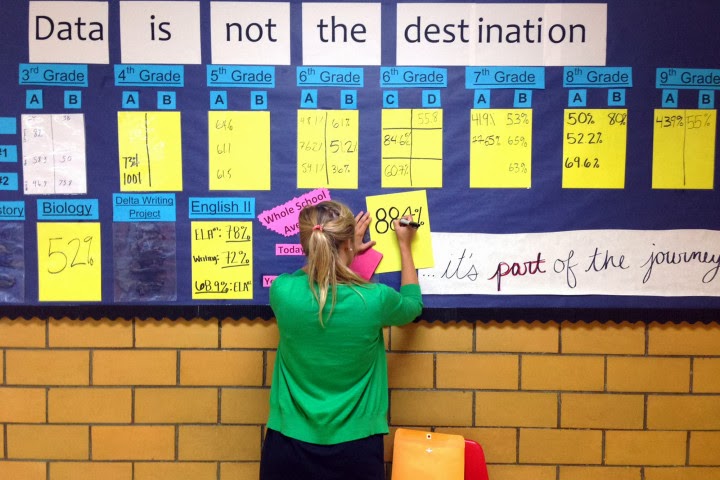
The above photo and text appeared with a NY Post editorial touting the wonders of Teach For America teachers over traditional public school teachers.
I want you to take a very close look at the photo.
The bulletin board says "Data is not the destination, it's part of the journey."
Between those words at the top and bottom of the bulletin board, the TFA teacher is updating her students daily data on Daily Data Wall.
I want you to think about the kind of classroom this woman runs, where daily data is tracked on every student and put up on a wall outside the classroom.
She must focus an awful lot on the kinds of things that can be quantified and tracked.
But what about the lessons in life that children need to learn that cannot be simplified and quantified, cannot be tracked, cannot be updated on the Daily Data Wall?
And how about the slogan "Data is not the destination, it's part of the journey"?
Can that slogan be true when data is tracked on every student every day and put up publicly on a wall outside the classroom?
Doesn't this Daily Data Wall equate students solely with their daily data record?
Doesn't this so Daily Data Wall send the message to students that they are their data?
Isn't this Daily Data Wall tantamount to child abuse?
Someday in the future, when the current crop of meritocrats and sociopaths running the country in positions of power in politics, business, public education and non-profits are graveyard data themselves, people are going to say "Did those people in the 21st century really believe that everything that mattered in life can be quantified and tracked? Did they really believe the data they tracked and used to make decisions - from the BLS jobs report to the inflation numbers to the value added's on teachers - was accurate and gave them enough information to make good and wise decisions?"
This fetishization of data will end when people begin to realize data-driven decisions are only as good as the data itself and more often than not in our world, data is manipulated, simplified, erroneous, or essentially useless because it doesn't give the whole picture.
Wednesday, May 1, 2013
Parents Fight The InBloom Inc. Plan
These were fighting words:
InBloom Inc. representatives were invited to the forum, but declined the invitation.
Already you can see how dismissive of parents's concerns they are.
The powers that be in Albany - Silver, Tisch, King, Cuomo - do not seem overly concerned about parents concerns either.
There are two bills - one in the Assembly and one in the Senate - that prohibit "the release of personally identifiable student information where parental consent is not provided."
We'll see how far those bills go.
I cannot think of time in my nearly half century of life when politicians and their bureaucratic functionaries are less responsive to parents and their constituencies over these kinds of issues in education than they are now.
A parent at the forum put the whole mess in crystal form:
Indeed.
"I know that you're just a messenger, so I want to make sure you deliver this message properly to your supervisors," parent and City Council candidate Jelani Mashariki told the Department of Education's deputy chief academic officer, Adina Lopatin, at a Borough Hall town hall packed with families Monday night.
"You're not going to give out my child's information to a third-party corporation to do whatever it is they want to do," Makarishi continued over whistles and applause from the audience. "The people are not going to have it and we are going to fight back."
Several other audience members had similar things to say regarding inBloom Inc., the controversial data-sharing initiative that parents at Monday night's volatile forum believe violates the privacy and security of their children. The $100 million initiative, funded by the Bill and Melinda Gates Foundation, the Carnegie Corporation, and federal grants, and built by News Corp's Wireless Generation, is responsible for designing something called an Education Data Portal in order to provide data tools to teachers and families.
As Lopatin later clarified, inBloom's EDP uses student data--including student demographics, parent contact information, dates of absence, suspensions, and state test scores--through an Amazon cloud-based service. That information is then shared with school-contracted vendors. The DOE maintains that this practice does not violate the Family Educational Rights and Privacy Act, and that vendors will not be able to even access the data without the school's permission, but there's also no provision for students and families to opt out.
"We live in 2013. Was anyone around last week when the AP was Twitter-hacked?" asked Natasha Capers, a parent and representative from the Alliance for a Quality Education. "It shut down New York City's Wall Street. We can only imagine what would happen when someone wants this information and knows how to utilize it properly."
InBloom Inc. representatives were invited to the forum, but declined the invitation.
Already you can see how dismissive of parents's concerns they are.
The powers that be in Albany - Silver, Tisch, King, Cuomo - do not seem overly concerned about parents concerns either.
There are two bills - one in the Assembly and one in the Senate - that prohibit "the release of personally identifiable student information where parental consent is not provided."
We'll see how far those bills go.
I cannot think of time in my nearly half century of life when politicians and their bureaucratic functionaries are less responsive to parents and their constituencies over these kinds of issues in education than they are now.
A parent at the forum put the whole mess in crystal form:
"We want to protect the privacy of our children," Lydia Bellahcene, a mother of five children in the public school system, told last night's town hall in one of the event's most impassioned speeches. "It is our God-given right. And I'm not signing that away because I put my daughter in public education."
Indeed.
Saturday, April 20, 2013
John King Takes His "Tour Of Fear" To Suburban Districts
Rick Hess told us earlier this school year that the goal of Common Core proponents is to ratchet up the standards and standardized tests three or four grade levels, have test scores drop dramatically, and scare the entire country into taking "education reformy" positions on charter schools, school choice, teacher tenure, school closures, etc.
In other words, there's a political agenda at play here, and it's the same one the education reformers/hedge fund managers have brought to urban school districts for years - only now they're aiming it at wealthier suburban school districts too.
And so, with this is mind, take a look at what NYSED Commissioner John King was doing this week as the state rolled out the vaunted new Common Core 3rd-8th grade ELA tests:
The education reformy, Common Core agenda is all there in King's little propaganda tour:
1. Tell suburban communities their schools aren't as good as they think they are
2. Instill fear that students are not receiving the "21st centuries skills" they will need to be successful in a globalized neo-liberal economy
3. Note that many more students are going to get 1's and 2's this year than in previous years
4. Note that Kentucky's scores fell dramatically when they instituted their Common Core "assessments" and New York's are expected to as well
Let's call this the John King "Tour of Fear," in which he goes around the state trying to sow as much doubt about schools and teachers as he can while playing on the fears and concerns parents have about how their children will fare in an increasingly technologized, financialized economy in which the only jobs created are at the top of the economic ladder or at the bottom.
Never mind that some of the "21st century skills" children will need to learn to thrive in this increasingly difficult time of transition in society - socio-emotional skills like balance, perspective, mindfulness and self-reflection - have been disdained by the Common Core architects and replaced with "rigor" and "argumentative writing" and mindless test drilling.
Never mind that the Common Core architects and reformers are waging war against the arts and creativity, pushing out drawing and painting, music and dance, and replacing it with "informational text reading," "argumentative essays" and "formative and summative assessments" to gauge "progress" on these fronts.
Never mind that Common Core architects and reformers are doing their best to instill FEAR and anxiety into every child in the state while forcing schools to have to de-fund many of the programs that nurture the heart and the soul of these children and replace them with technology for testing, test preparation materials and test prep classes.
Given that we live in an increasingly overpopulated, underresourced world, a world where the top 1% are stealing more and more of the wealth and resources and leaving the rest of us to fight it out over the crumbs, I think the education system ought to be teaching a different set of "21st century skills" than John King, Merryl Tisch and the rest of the edu-entrepreneurs and education corporatists want taught.
In fact, this so-called "education reform" education corporatists like John King and Merryl Tisch are pushing is another example of how that 1% steal wealth and resources from the rest of us as they gobble up more and more of the education dollars for their corporate products (the tests are even using corporate trademarks and advertising slogans!), data tracking and the like.
And they do all of this while also working to create a generation of children who will grow up to be compliant consumers and obedient workers fearful of not hitting their benchmarks.
Michael Fiorillo crystallized this in a comment recently:
The primary tool they use to drive their reforms is FEAR and the primary weapons they're using are tests and test score data.
They thought they were winning the battle quite handily, as they have driven their reforms through quite easily with little pushback , but as they're learning this week, parents around the state are not so easily cowed and are beginning to fight back.
With some conservatives and Republicans also waking up to the corporate education reform agenda, the education reformers and Common Core proponents are going to have to wage a war on two fronts.
That's why King and Tisch and the rest of the reformers are using so much FEAR this week to try and win the public over to their agenda.
That's why they've taken to the air waves, courtesy of corporate dollars from General Electric and Exxon Mobil, with a pro-Common Core propaganda campaign.
They're worried that a tipping point may soon be reached on education reform, high stakes testing, Common Core and other reformy positions that will not be going their way.
In other words, there's a political agenda at play here, and it's the same one the education reformers/hedge fund managers have brought to urban school districts for years - only now they're aiming it at wealthier suburban school districts too.
And so, with this is mind, take a look at what NYSED Commissioner John King was doing this week as the state rolled out the vaunted new Common Core 3rd-8th grade ELA tests:
WHITE PLAINS — State EducationCommissioner John B. King Jr. said Thursday that even the high-achieving school districts of the Lower Hudson Valley have much to gain from the new Common Core learning standards and the tougher, revamped state tests that began debuting this week.“I wish it were true that our suburban communities were doing just fine,” he told the Editorial Board of The Journal News.
King said that it’s not enough that suburban districts send most graduates to four-year colleges
King has been on a statewide campaign in recent weeks to explain that large percentages of students are likely to see their performance drop on the new state tests. A three-day English and Language Arts test concluded Thursday for students in grades three to eight. New math tests will be given April 24 to 26.
In New York, students are graded on a 1-4 scale for each test, with grades of 3 and 4 representing “proficiency.” Many more students are likely to get 1s and 2s on the new tests, meaning they won’t be reaching state standards.
King noted that in Kentucky, the first state to use tests based on the Common Core, the percentage of students hitting state targets fell 35 percent.
The education reformy, Common Core agenda is all there in King's little propaganda tour:
1. Tell suburban communities their schools aren't as good as they think they are
2. Instill fear that students are not receiving the "21st centuries skills" they will need to be successful in a globalized neo-liberal economy
3. Note that many more students are going to get 1's and 2's this year than in previous years
4. Note that Kentucky's scores fell dramatically when they instituted their Common Core "assessments" and New York's are expected to as well
Let's call this the John King "Tour of Fear," in which he goes around the state trying to sow as much doubt about schools and teachers as he can while playing on the fears and concerns parents have about how their children will fare in an increasingly technologized, financialized economy in which the only jobs created are at the top of the economic ladder or at the bottom.
Never mind that some of the "21st century skills" children will need to learn to thrive in this increasingly difficult time of transition in society - socio-emotional skills like balance, perspective, mindfulness and self-reflection - have been disdained by the Common Core architects and replaced with "rigor" and "argumentative writing" and mindless test drilling.
Never mind that the Common Core architects and reformers are waging war against the arts and creativity, pushing out drawing and painting, music and dance, and replacing it with "informational text reading," "argumentative essays" and "formative and summative assessments" to gauge "progress" on these fronts.
Never mind that Common Core architects and reformers are doing their best to instill FEAR and anxiety into every child in the state while forcing schools to have to de-fund many of the programs that nurture the heart and the soul of these children and replace them with technology for testing, test preparation materials and test prep classes.
Given that we live in an increasingly overpopulated, underresourced world, a world where the top 1% are stealing more and more of the wealth and resources and leaving the rest of us to fight it out over the crumbs, I think the education system ought to be teaching a different set of "21st century skills" than John King, Merryl Tisch and the rest of the edu-entrepreneurs and education corporatists want taught.
In fact, this so-called "education reform" education corporatists like John King and Merryl Tisch are pushing is another example of how that 1% steal wealth and resources from the rest of us as they gobble up more and more of the education dollars for their corporate products (the tests are even using corporate trademarks and advertising slogans!), data tracking and the like.
And they do all of this while also working to create a generation of children who will grow up to be compliant consumers and obedient workers fearful of not hitting their benchmarks.
Michael Fiorillo crystallized this in a comment recently:
As management guru Peter Drucker famously said, "That which can be measured, can be managed."
As you say, it's about measurement of monetized data (formerly known as students) and control of the workforce.
The primary tool they use to drive their reforms is FEAR and the primary weapons they're using are tests and test score data.
They thought they were winning the battle quite handily, as they have driven their reforms through quite easily with little pushback , but as they're learning this week, parents around the state are not so easily cowed and are beginning to fight back.
With some conservatives and Republicans also waking up to the corporate education reform agenda, the education reformers and Common Core proponents are going to have to wage a war on two fronts.
That's why King and Tisch and the rest of the reformers are using so much FEAR this week to try and win the public over to their agenda.
That's why they've taken to the air waves, courtesy of corporate dollars from General Electric and Exxon Mobil, with a pro-Common Core propaganda campaign.
They're worried that a tipping point may soon be reached on education reform, high stakes testing, Common Core and other reformy positions that will not be going their way.
Wednesday, April 3, 2013
Data-Driven Reform That Has Lost Sight Of Realities
The Village Voice reports that small class sizes, individualized instruction via a real teacher and not a Joel Klein computer program and mastery design courses rather than endless standardized test prep actually helps students learn:
In the Bloomberg Era, we have also gotten data-driven accountability based upon test scores and graduation rates which means if the students do not pass the test and do not graduate on time, it is the fault of the teachers, the administrators and the schools and all will be held accountable.
Under the new APPR state evaluation system, that means teachers may be fired.
Under Bloomberg's Reign of Error over the NYCDOE, that means hundreds of schools may be closed, reopened as new schools and then closed again.
You always here this jive statement from corporate ed deformers and charter school cheerleaders when they're talking about schools: "We know what works."
Most of them mean busting the teachers union and firing "bad teachers."
But we really do know what works in education and what has worked for a long, long time:
Small class sizes, individualized instruction via a real teacher and not a Joel Klein computer program and mastery design courses rather than endless standardized test prep actually helps students learn.
Too bad in the era of data-driven accountability, in the era of the Bushes and the Obamas and the Rhees and Kleins and Spellings and Paiges and Duncans, there is no time or money to experiment with methods that actually work to improve education.
These people are too busy branding teachers "bad" and schools "failing" and looking for ways to shut the whole system down and privatize it.
Because the agenda in education reform is not improve schools or help students.
It is to privatize the last great public institution that hasn't been privatized yet and profit from it.
CUNY began experimenting in 2007 with a different approach to remediation. Jahleah Santiago and Ashley Baret are in the START program, an intensive 12-week immersion designed for students with remedial needs in one, two, or all three areas.
Nathan Stevens, Baret and Santiago's START teacher, has a luxury few of his CUNY colleagues enjoy: time, a total of 15 hours a week with these students. On a recent afternoon, he stands at the whiteboard, going over eight homework problems, encouraging all 14 students (average class size is 20) to verbalize their thought processes. A scruffy figure with a beard and tattoos, Stevens is relentlessly Socratic—"How do you know that you're finished with the factors now?"—and patiently draws out each student, who range in age from teens to fifties, as the class simplifies polynomials and multiplied exponents: "Put it into words, Manny. Tell me how you got that answer."
Seventeen hundred students are in the START program this spring. They are technically deferring admission to CUNY, paying the $75 fee out of pocket so they don't start the Pell Grant clock. Their curriculum was written especially for the program, and all instructors spent a full semester training with another teacher in the classroom. "In this program we seek to show what's really happening in the math," Stevens says. "Rather than teaching my students to memorize the formulas, tricks, rules, I try to reinforce the underlying ideas of what they're looking at, with the hope that they could solve any problem they see."
"In my high school, math was kind of under a veil," says Santiago. "You didn't know what was going on—you just do that and that and get the answer. Nathan will break it down and do different examples until we get it."
That process sounds an awful lot like what we used to think of as "teaching." And 60 to 70 percent of START students, most of whom set out with multiple remedial needs, gain proficiency in a given subject after just one semester, compared with 20 percent who take regular remedial courses. The program began in 2009, building on the model of ASAP, a full-year intensive program. CUNY also opened an entire school called New Community College near Bryant Park last fall; all three programs feature intensive, accelerated study, small classes, and individual attention. START and ASAP will both double in size this fall to a total of 8,000 students. "It's amazing, the progress I see in such a short time," says Stevens, putting his hand over his heart with unabashed sincerity. "The students leave me, they pass the test, I see them later in the hallways, and they tell me how well they're doing. They hold on to their notes from my class. It just gives you that wonderful teacher feeling."
Doing things this way isn't just warm and fuzzy—it also seems surprisingly cost-effective. While it's initially more expensive to have small classes with extra advisors and tutors, of the original cohort who entered ASAP in 2007, 55 percent earned their associates' degree in three years, compared with 24.7 percent of similar students in the broader CUNY campus and just 16 percent of urban community college students nationally. According to an independent study by the Center for Benefit-Cost Studies of Education at Columbia, the graduation rates were so much higher that ASAP cost about 10 percent less per graduate.
At its heart, this story is about a complex set of math problems. CUNY is beginning to make headway with this reinvented approach to remediation, but the underlying paradox persists: It is still spending considerable money and time, its own and its students', to teach people what they should have already learned.
The contradiction is stark. If the city's Department of Education were to adopt the practices of START and ASAP—small class sizes, mastery-based course design, one additional counselor or adviser for every 25 students—it seems likely that more students would progress on grade level, and the system as a whole would actually save money. The trend, however, is in the opposite direction: 13 percent cumulative budget cuts since 2007, and larger classes at 60 percent of middle and high schools as of last fall. It's no wonder the remediation numbers keep rising.
In the Bloomberg Era, we have also gotten data-driven accountability based upon test scores and graduation rates which means if the students do not pass the test and do not graduate on time, it is the fault of the teachers, the administrators and the schools and all will be held accountable.
Under the new APPR state evaluation system, that means teachers may be fired.
Under Bloomberg's Reign of Error over the NYCDOE, that means hundreds of schools may be closed, reopened as new schools and then closed again.
You always here this jive statement from corporate ed deformers and charter school cheerleaders when they're talking about schools: "We know what works."
Most of them mean busting the teachers union and firing "bad teachers."
But we really do know what works in education and what has worked for a long, long time:
Small class sizes, individualized instruction via a real teacher and not a Joel Klein computer program and mastery design courses rather than endless standardized test prep actually helps students learn.
Too bad in the era of data-driven accountability, in the era of the Bushes and the Obamas and the Rhees and Kleins and Spellings and Paiges and Duncans, there is no time or money to experiment with methods that actually work to improve education.
These people are too busy branding teachers "bad" and schools "failing" and looking for ways to shut the whole system down and privatize it.
Because the agenda in education reform is not improve schools or help students.
It is to privatize the last great public institution that hasn't been privatized yet and profit from it.
Monday, April 1, 2013
Michael Bloomberg Belongs In Jail Next To Beverly Hall
Via Diane Ravitch, here is Sol Stern at The Daily Beast comparing Georgia governor Sonny Perdue's response to the Atlanta cheating allegations compared to Michael Bloomberg's here in NYC:
I have written over and over that if Mayor Bloomberg's tenure here as mayor was given a going over with a fine-toothed comb by an independent auditor not beholden to the mayor and not needing future employment and/or largesse from either the mayor or his corporate buddies, the crime statistics, the fire fatality statistics and the emergency response time statistics, the test scores and the graduation rates would all be found to be fraudulent.
Here's an example outside of education and crime of how Bloomberg funks with the numbers here in the city.
Currently Bloomberg claims New York City has the lowest fire fatality rate in history - and the mayor says this is because they have the fastest response time they have ever had:
But a notorious report done at the behest of the city by Winbourne Consulting on the city's troubled 911 system found the following:
But Mayor Bloomberg, the second richest American, is not going to receive that once over - not by a press that he owns, not by politicians who fear his PAC and his wrath.
Quite frankly, if Beverly Hall is put in prison for tampering with student test papers, along with other charges such as “racketeering, theft, making false statements and false swearing," if she is facing jail time for creating "an environment where achieving the desired end result was more important than the students’ education," than Michael Bloomberg and his chancellor Joel Klein belong in cells next to her.
And as long as we're talking criminal liability for stat juking and data manipulation, NYPD Commissioner Ray Kelly certainly should be investigated as well.
I am under no illusion that that will happen, of course.
The black woman formerly running the Atlanta school district, along with the largely black educators who were indicted with her, will face justice in their scandal.
But the rich white man who owns NYC, along with his white male toadies like Klein and Kelly, will almost certainly not.
As I read about the indictments, I could not help but compare what Governor Perdue did in Atlanta with the way Mayor Michael Bloomberg handled allegations of test fraud during his 12 years at the helm of New York City’s schools. Like Beverly Hall and other Atlanta officials, Bloomberg proclaimed miraculous gains in student achievement as a result of the reforms he instituted after the state legislature gave him control of the city’s school system in 2002. In the midst of his 2005 reelection campaign Bloomberg invited the city press corps to PS 33, an elementary school in one of the Bronx’s poorest neighborhoods to hear about one of those academic miracles. The school and its principal, Elba Lopez, had just hit the jackpot on the state’s fourth-grade reading test. Over 83 percent of the 140 fourth-graders scored at or above proficiency (or grade level), Mayor Bloomberg announced, compared with only 35.8 percent proficiency in 2004. Like Atherton Elementary in Atlanta, this was a “statistically improbable” one-year gain of close to 50 percentage points. The scores for these predominantly minority and poor students were just four percentage points below the average for the richest suburban districts in the state. According to the mayor, the test results proved that his education reforms “really are paying off for those who were previously left behind.” Not a single reporter at the press conference questioned the mayor’s claim of historic, unprecedented educational gains.
Shortly after the test scores were announced, Elba Lopez retired, collecting a $15,000 bonus for her school’s spectacular performance, thus boosting her pension by as much as $10,000 per year. In 2006 the same cohort of students, now fifth-graders, fell back to a pass rate of only 47 percent, and the pass rate for the new crop of fourth-graders was just 41 percent. After I reported this startling turnabout in City Journal and reporter Andrew Wolf did the same in the New York Sun, it became fairly obvious that someone had tampered with the students’ 2005 exams. With Mayor Bloomberg successfully reelected, even his own Department of Education (DOE) felt some pressure and said it would take a second look. Schools Chancellor Joel Klein asked his Counsel, Michael Best, to refer the matter to the city’s Department of Investigations (DOI). But Best left the referral on his desk for six months. (“I goofed,” he said, when I asked why he delayed the referral.) But the DOI, whose head Richard Condon is appointed by the Mayor, declined to take the case. It was then left to the DOE’s small and understaffed investigative unit to follow up. The department had waited almost two years to start an investigation, and by this time the suspicious test papers had been destroyed.
In a report issued almost four years after the tests were administered the department’s lone investigator found no wrongdoing, yet neglected to interview PS 33’s principal Elba Lopez. As the New York Post explained in its singularly pithy way, City clears self. When I asked DOE counsel Best how the most likely suspect could be cleared without even an interview, he responded that the department’s investigator “couldn’t find her.” A few months later, New York Post reporter Yoav Gonen located Lopez at her apartment in the Bronx, exactly where she had always lived. Lopez assured the Post that there was no cheating; the reason that the students didn’t maintain their spectacularly high scores for more than one test cycle, she explained, was that the school had a new, inexperienced principal.
I have written over and over that if Mayor Bloomberg's tenure here as mayor was given a going over with a fine-toothed comb by an independent auditor not beholden to the mayor and not needing future employment and/or largesse from either the mayor or his corporate buddies, the crime statistics, the fire fatality statistics and the emergency response time statistics, the test scores and the graduation rates would all be found to be fraudulent.
Here's an example outside of education and crime of how Bloomberg funks with the numbers here in the city.
Currently Bloomberg claims New York City has the lowest fire fatality rate in history - and the mayor says this is because they have the fastest response time they have ever had:
"With record low number of murders and shootings and the fewest fire deaths in our city's history, 2012 was a historic year for public safety," Bloomberg said. "The FDNY has consistently improved fire safety over the past decade and has continued to drive response times to historic lows. These achievements and the efforts by our firefighters, EMT's and paramedics to save lives - while putting theirs on the line - is the reason fewer New Yorkers died as a result of fire in 2012 than ever before."
But a notorious report done at the behest of the city by Winbourne Consulting on the city's troubled 911 system found the following:
The group also accused the city of using inaccurate response times, since the city fails to include the amount of time it takes for a 911 operator to answer a call and loop in the relevant dispatcher — as other cities do.
“This practice inhibits the ability of the NYPD and FDNY Fire and EMS to generate accurate Response Time Information,” the report writes.
But Mayor Bloomberg, the second richest American, is not going to receive that once over - not by a press that he owns, not by politicians who fear his PAC and his wrath.
Quite frankly, if Beverly Hall is put in prison for tampering with student test papers, along with other charges such as “racketeering, theft, making false statements and false swearing," if she is facing jail time for creating "an environment where achieving the desired end result was more important than the students’ education," than Michael Bloomberg and his chancellor Joel Klein belong in cells next to her.
And as long as we're talking criminal liability for stat juking and data manipulation, NYPD Commissioner Ray Kelly certainly should be investigated as well.
I am under no illusion that that will happen, of course.
The black woman formerly running the Atlanta school district, along with the largely black educators who were indicted with her, will face justice in their scandal.
But the rich white man who owns NYC, along with his white male toadies like Klein and Kelly, will almost certainly not.
Tuesday, December 11, 2012
So Much For Finland
Read this article in Gates Education Week about the TIMSS and PISA scores and you will learn that on the latest tests, Finland is no longer the "miracle" education performer:
The hand-wringing and kvetching that accompanies these articles about international test comparison studies are over the top.
The obsession with data tracking leads many so-called (and usually self-professed) education "experts" to declare a latest, greatest "miracle" every time out and shriek about how we MUST follow this latest, greatest "miracle" or risk falling into second class country status.
It's interesting how often the "latest, greatest" miracle is shown to be neither the "greatest" nor a "miracle" a couple of studies down the road.
Here in the U.S. we of course had the "Houston Miracle" and the "Texas Miracle" and the "Florida Miracle" and all of those were eventually exposed as fraudulent or oversold.
Now Brookings and a few others in this latest Gates Education Week article on the international scores are saying, "Maybe Finland, while a terrific performer, isn't the 'miracle' we thought it was..."
This begs the question, why do we listen to all the hand-wringing and kvetching from the so-called (and often self-professed) education "experts" when so many of the "miracles" they share with us turn to either be fraudulent (as in Houston) or oversold (as in Finland.)
Is it just possible that the so-called (and often self-professed) education "experts" don't know what they're talking about ?
Is it possible there is more to education than just this obsession with data?
Is it possible these international test comparisons tell us a lot less than we think about the state education?
Tom Loveless, a senior fellow at the Brookings Institution, a Washington think tank, said in an email that the new results call for some rethinking of what he calls the “Finnish miracle story.”
“If Finland were a state taking the 8th grade NAEP, it would probably score in the middle of the pack,” he said, in a reference to the National Assessment of Educational Progress. He said that four of the U.S. states that participated in the 8th grade TIMSS—Massachusetts, Minnesota, North Carolina, and Indiana—posted scores that were higher than Finland’s by statistically significant margins in math, while three more had results that were about the same.
“Finland’s exaggerated reputation is based on its performance on PISA, an assessment that matches up well with its way of teaching math (applying math to solve ‘real world’ problems),” he wrote. “In contrast, TIMSS tries to assess how well students have learned the curriculum taught in schools.”
At the same time, Finland made a stronger showing than the United States in 4th and 8th grade science on TIMSS. In the 8th grade, for instance, Finland scored 552, compared with 525 for the United States. Measured another way, 53 percent of Finnish 8th graders reached either the “high” or the “advanced” level, the top two categories, compared with 40 percent of their peers in the United States.
Even so, Finland’s performance fell short of the results for the top-performing East Asian countries. It also was lower than Massachusetts’ score of 567.
The hand-wringing and kvetching that accompanies these articles about international test comparison studies are over the top.
The obsession with data tracking leads many so-called (and usually self-professed) education "experts" to declare a latest, greatest "miracle" every time out and shriek about how we MUST follow this latest, greatest "miracle" or risk falling into second class country status.
It's interesting how often the "latest, greatest" miracle is shown to be neither the "greatest" nor a "miracle" a couple of studies down the road.
Here in the U.S. we of course had the "Houston Miracle" and the "Texas Miracle" and the "Florida Miracle" and all of those were eventually exposed as fraudulent or oversold.
Now Brookings and a few others in this latest Gates Education Week article on the international scores are saying, "Maybe Finland, while a terrific performer, isn't the 'miracle' we thought it was..."
This begs the question, why do we listen to all the hand-wringing and kvetching from the so-called (and often self-professed) education "experts" when so many of the "miracles" they share with us turn to either be fraudulent (as in Houston) or oversold (as in Finland.)
Is it just possible that the so-called (and often self-professed) education "experts" don't know what they're talking about ?
Is it possible there is more to education than just this obsession with data?
Is it possible these international test comparisons tell us a lot less than we think about the state education?
Monday, November 12, 2012
Brian Eno On Education, Society's Need To Quantify Everything, And The Data Fetish,
Fascinating discussion between Brian Eno and economist Ha-Joon Chang in The Guardian about a whole host of things including education reform, quantification and the "data fetish".
Read the whole thing, but here's an interesting snippet:
That's an excellent diagnosis of what ails our society - the insatiable need for top-down control, to quantify everything and to deify data.
This is of course what seriously ails our education system.
Add in the profit motive and you have the recipe for neo-liberal disaster capitalism.
Or education reform as brought to us by Barack Obama, Andrew Cuomo, and Michael Bloomberg.
Read the whole thing, but here's an interesting snippet:
HJC: Oh yeah, but my view is that we don't live by bread alone. We have to accept political considerations, and cultural and social considerations …
These days, economics has become such an all-encompassing way of thinking that everything is supposed to justify its existence by how much money it makes. Are you making enough money as a university? Are you making enough money as a classical orchestra? I think it's a fundamentally wrong approach to life. Because economics might be the foundation, if you like … but if you try to create a world in which everything is driven by money and the market, the world will be a much poorer place.
Imagine if all those kings and dukes hadn't commissioned those crazy cathedrals, paintings and music … we'd still be living in sticks and mud. Because none of those things made any economic sense. Human beings' capacity to "waste time" is a miracle – but that's exactly what art is for.
BE: Ha-Joon came up with a good title for a book that I might write: "A Total Waste of Time"!
CLS: Are these questions increasingly urgent, because over the course of the last couple of decades, that rightwing mindset has won out – we have rightwing figures now who, 20 years ago, would have been beyond the pale?
HJC: Absolutely. These ideas have penetrated so deeply into our society, it's poisonous.
BE: It's not only money, it's also other forms of accountability. Look at education in this country. I've just had two daughters go through the system here, and nothing mattered at all, as long as they could get through their A-levels. It doesn't matter if you don't actually understand a word. I could see some of their friends who were good at remembering things, but had no clue at all about what they were talking about, who got A stars.
HJC: In that system, curiosity is actually a great disadvantage. Which means that any creativity gets lost.
BE: It's to do with the act of quantification. It's part of the money thing: something that you can put a figure to immediately assumes a sort of authority, even if it doesn't deserve it.
What is the value of a park? You can't quantify it. We keep them because we've inherited them. But I'm sure there'll be a rightwing movement in the future that says, "Parks? What are they for? People just wander about in them – and there's dog shit all over the place. What's the point of that? A great big piece of real estate in the middle of London that could be generating income – we can quantify that." Quantification is a big temptation for society because it looks like control.
HJC: People tend to think that numbers are quite objective, but numbers in economics are not like this. Some economists say they're like sausages: you don't know what they really are until you cut into them. Once you know, you become very sceptical ...
I'm not against numbers. You need some numbers, to work with. Life would be impossible otherwise. But we've made these numbers into fetishes.
Art is not the only area affected by this quantification – education has been affected, family relationships, too – but I think art is the most endangered area of life. It's not obvious how something makes money. Sometimes, you have an artwork that you think is terrible, but then some billionaire is prepared to pay a huge amount for it, and suddenly it becomes valuable. And you are supposed to like it because it's expensive, and it must be expensive because it's worth it. So even the values within the art world are distorted.
That's an excellent diagnosis of what ails our society - the insatiable need for top-down control, to quantify everything and to deify data.
This is of course what seriously ails our education system.
Add in the profit motive and you have the recipe for neo-liberal disaster capitalism.
Or education reform as brought to us by Barack Obama, Andrew Cuomo, and Michael Bloomberg.
Sunday, October 7, 2012
The End Game For The Reform Data Fetishists
The NY Times reports that one Texas district is piloting tracking students through electronic ID's:
Oh, boy - think of the data mining possibilities with this "innovation".
It's enough to give Joel Klein, Bill Gates and Rupert Murdoch Texas-sized hard-ons without the Viagra pills.
And be sure, this abomination will spread, billed as some "safety" innovation or cost-savings.
But of course we know exactly why the powers that be want ID tags on students (and teachers too.)
It's easier to track everything they do, everything they buy, everything they eat, everywhere they go and, eventually, everything they think and feel.
That's why Gates was experimenting with the Galvanic skin response bracelets that measure so-called student engagement in the classroom.
The boys running the country want to control everything, as much for commercial purposes as for political purposes - and more and more, technology is allowing them to do just that.
It's not a mistake that the ID tags that used to be used for products and cattle are now on people.
We're the product.
SAN ANTONIO — For Tira Starr, an eighth grader at Anson Jones Middle School, the plastic nametag hanging around her neck that she has decorated with a smiley face and a purple bat sticker offers a way to reflect her personal flair. For administrators, it is something else entirely: a device that lets them use radio frequency technology — with scanners tucked behind walls and ceilings — to track her whereabouts.Anson Jones is the first school in San Antonio’s Northside Independent School District to roll out the new nametags, which are part of a pilot program intended to ensure that the district receives all of the state dollars to which it is entitled....But the radio frequency identification nametags have prompted concerns from civil liberties groups and electronic privacy watchdogs, which fear a Big Brother atmosphere in Texas public schools.
Matthew Simpson, a policy strategist for the American Civil Liberties Union of Texas, said the technology was easy to acquire, meaning people outside a school might be able to monitor a student if they obtained the student’s unique tracking number.Mr. Simpson said the technology was originally designed for shipping goods and for cattle. “It was never intended for people,” he said.
Oh, boy - think of the data mining possibilities with this "innovation".
It's enough to give Joel Klein, Bill Gates and Rupert Murdoch Texas-sized hard-ons without the Viagra pills.
And be sure, this abomination will spread, billed as some "safety" innovation or cost-savings.
But of course we know exactly why the powers that be want ID tags on students (and teachers too.)
It's easier to track everything they do, everything they buy, everything they eat, everywhere they go and, eventually, everything they think and feel.
That's why Gates was experimenting with the Galvanic skin response bracelets that measure so-called student engagement in the classroom.
The boys running the country want to control everything, as much for commercial purposes as for political purposes - and more and more, technology is allowing them to do just that.
It's not a mistake that the ID tags that used to be used for products and cattle are now on people.
We're the product.
Subscribe to:
Posts (Atom)